
AQFP Basics
AQFP stands for Adiabatic Quantum-Flux Parametron. It is a superconducting logic family designed for extremely low energy operation. Compared with SFQ, AQFP is usually slower, but it can dissipate far less energy per operation.
Why Look Beyond RSFQ?
Conventional RSFQ is fast, but it has two major energy costs:
- static power: bias resistors continuously dissipate power,
- dynamic power: junction switching dissipates energy during each pulse event.
Later SFQ families reduce static power, but non-adiabatic switching still has an energy cost. AQFP attacks the problem differently: switch slowly and recover energy.
Landauer Limit
The Landauer principle says that erasing one bit of information dissipates at least:
This does not mean every computation must dissipate that much. The limit applies to irreversible information erasure. If a computation is logically reversible and the physical switching is adiabatic, energy can in principle be much lower.
Non-Adiabatic vs Adiabatic Switching
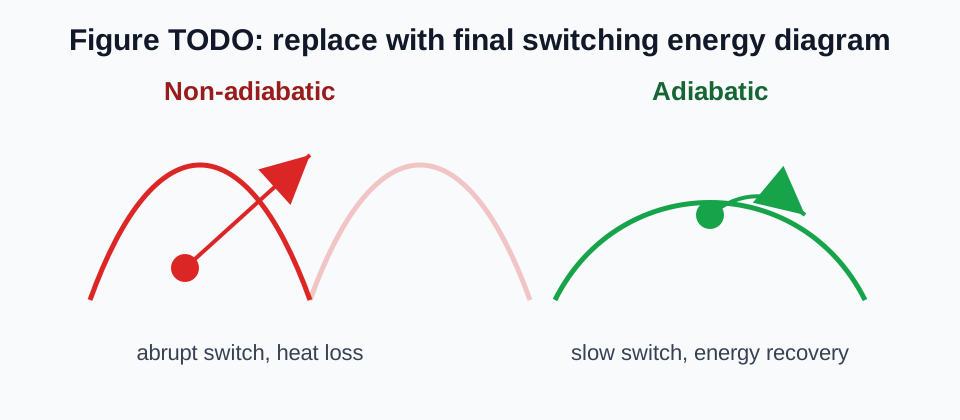
In non-adiabatic switching, energy supplied by the power source is mostly dumped as heat when the state changes.
In adiabatic switching, the potential landscape changes slowly enough that most of the supplied energy returns to the source. The switch follows the changing energy minimum rather than being kicked over a barrier.
Mental model:
| Switching Style | Intuition | Energy Picture |
|---|---|---|
| Non-adiabatic | Push hard | Supplied energy is mostly dissipated |
| Adiabatic | Move slowly | Much of the supplied energy can return to the source |
Figure TODO
Recommended figure: two potential-energy sketches comparing abrupt non-adiabatic switching and slow adiabatic switching.
Image path used by this page: /figures/fundamentals/adiabatic-switching-comparison.svg
AQFP Operating Idea
AQFP uses superconducting loops and Josephson junctions driven by an AC excitation current. The AC bias both powers and clocks the circuit. The output state is determined by the direction of circulating current or flux state selected during the excitation cycle.
Important features:
- near-zero static power,
- AC-powered operation,
- adiabatic switching,
- energy recovery through superconducting power distribution,
- very low bit energy compared with conventional RSFQ.
AQFP vs SFQ
| Feature | SFQ / RSFQ | AQFP |
|---|---|---|
| Primary goal | Speed | Energy efficiency |
| Signal style | Quantized voltage pulses | Adiabatic state evolution |
| Power style | DC bias in conventional RSFQ | AC excitation / clock |
| Static power | Can be significant in RSFQ | Ideally near zero |
| Typical challenge | Biasing, memory, pulse timing | Clocking, latency, circuit style |
Reversible Computing Connection
If a logic operation throws away information, it pays the Landauer cost. Reversible gates preserve enough information to reconstruct the input from the output. AQFP is interesting because very low-energy adiabatic switching makes reversible computing physically meaningful rather than only theoretical.
This does not mean every AQFP circuit is automatically reversible. It means AQFP is a promising platform for studying logic where energy recovery and information preservation are central design goals.
Beginner Pitfalls
- "AQFP is just slower SFQ." It uses a different operating principle: adiabatic switching with AC excitation.
- "
is a normal gate energy target." It is a thermodynamic limit for irreversible bit erasure, not a guarantee for arbitrary circuits. - "Low device energy means easy system design." Clock distribution, latency, interfaces, and cryogenic system overhead still matter.
- "Reversible computing means no energy." Practical circuits always have nonidealities; the goal is to reduce unavoidable dissipation.
Training Exercise
- Explain static and dynamic power in conventional RSFQ.
- In your own words, describe Landauer's principle.
- Draw two curves: abrupt switching and slow adiabatic switching. Mark where energy is dissipated or recovered.
- Compare SFQ and AQFP for a system that values speed more than energy, then for a system that values energy more than speed.
Next
After this page, move into Design Constraints and the Design and EDA section.