
SQUID Basics
A SQUID is a superconducting loop interrupted by one or more Josephson junctions. For SFQ learning, the most useful SQUID idea is not only "sensitive magnetometer." It is that a loop plus junctions creates controllable flux states.
The Basic Object
An rf-SQUID has one Josephson junction in a superconducting loop. A dc-SQUID has two junctions. In both cases, the loop can store flux, and the junctions allow flux to enter or leave by phase slips.
Conceptually:
| Ingredient | Role |
|---|---|
| Superconducting loop | Stores quantized flux |
| Josephson junctions | Let flux enter or leave by phase slips |
| Bias current or flux | Tilts the energy landscape into useful logic states |
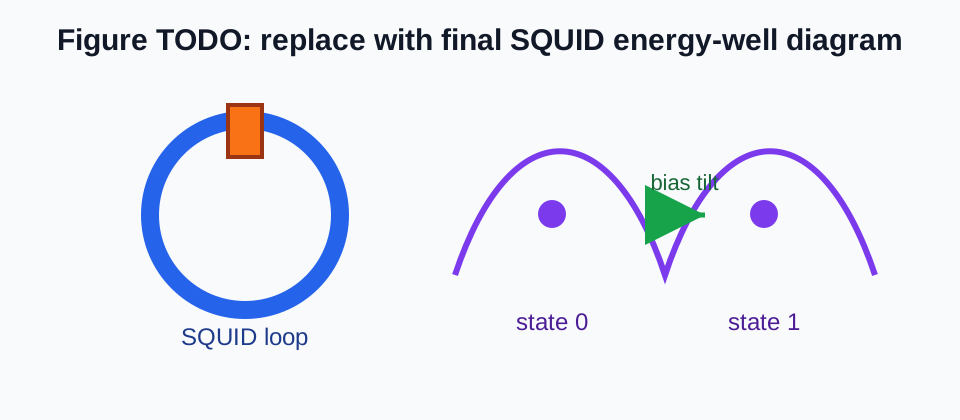
Figure TODO
Recommended figure: rf-SQUID or dc-SQUID loop with Josephson junctions, showing bias current/flux and two energy wells.
Image path used by this page: /figures/fundamentals/squid-energy-wells.svg
Energy Well Intuition
The SQUID has an energy landscape. Stable circuit states correspond to local minima of that energy. When current or magnetic flux is applied, the energy landscape tilts.
This gives a digital picture:
- one minimum can represent
0, - another minimum can represent
1, - a bias can make switching between minima possible,
- a junction phase slip moves the system between flux states.
This is why potential-energy diagrams are common in superconducting logic explanations.
Bias Current and Bias Flux
Bias is a controlled push applied to the circuit. It is not the data itself, but it prepares the circuit so that data pulses can move.
Bias can be:
- current bias: a current source that tilts junction/loop behavior,
- flux bias: an applied magnetic flux that shifts the preferred loop state,
- AC bias: a time-varying drive used in AQFP and some other logic styles.
In SFQ circuits, bias is essential because it brings junctions close enough to switching that an incoming pulse can trigger the next event.
Bistable and Tristable Pictures
Digital logic needs distinguishable states. A SQUID-like circuit can be designed to have:
- bistable potential: two useful states, often associated with
0and1, - tristable potential: three possible wells where one may be unused, useful for explaining directional flux propagation.
The exact circuit can be complex, but the training intuition is simple:
Bias shapes the landscape; a flux quantum moves the state.
Why This Matters for SFQ
SFQ circuits are built from loops, inductors, and Josephson junctions. A pulse arriving at one stage changes phase and flux, which changes the local energy landscape and causes the next junction to switch. This is how a flux quantum can propagate through a chain.
Beginner Pitfalls
- "SQUID only means sensor." In digital circuits, SQUID-like loops also serve as controllable flux-state elements.
- "Bias current is the signal." Bias enables switching; the signal is usually the flux/pulse event.
- "Flux just flows like charge." Flux states are constrained by loop phase and quantization.
Training Exercise
- Draw a double-well potential and label the two wells
0and1. - Draw how the potential changes when bias is applied.
- Explain what must happen for the state to move from one well to the other.
- Write one sentence explaining why SFQ circuits need bias.
Next
Continue to SFQ Basics, where these loop and junction ideas become digital pulse circuits.