
SFQ Basics
SFQ means Single Flux Quantum. In SFQ logic, information is represented by the presence, absence, timing, or storage of individual flux quanta. A switching Josephson junction produces a short voltage pulse whose time integral is exactly one flux quantum.
The Core Idea
In CMOS, a bit is often represented by a voltage level. In SFQ, a bit event is represented by a pulse:
| Step | Physical Meaning |
|---|---|
| 1 | One junction phase slip of |
| 2 | One voltage pulse appears |
| 3 | The pulse area satisfies |
| 4 | One flux quantum moves or is stored |
This makes SFQ pulse logic naturally fast, because Josephson phase motion can occur on picosecond time scales.
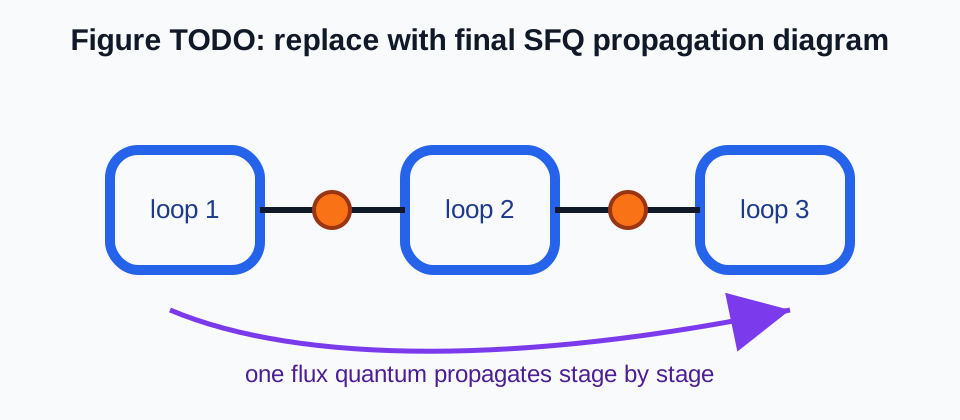
Figure TODO
Recommended figure: SFQ propagation through two or three loop-and-junction stages, showing one flux quantum moving stage by stage.
Image path used by this page: /figures/fundamentals/sfq-propagation-chain.svg
What Stores Information?
Superconducting loops can store an integer number of flux quanta. In many SFQ circuits, the stored flux state of a loop is the memory of the circuit. Josephson junctions are used to add or remove flux quanta from those loops.
Short version:
- loops store flux,
- junctions switch flux in or out,
- pulses communicate events between circuit stages.
Why Bias Current Is Needed
An incoming pulse alone is usually not enough to make a large circuit operate reliably. Bias current brings each junction close to its switching condition. Then a pulse can push the correct junction over the threshold.
Bias also affects timing and robustness. Poor bias distribution can cause:
- changed propagation delay,
- local magnetic-field disturbance,
- unintended switching,
- reduced operating margins.
SFQ Pulse Propagation
A useful way to think about propagation is:
- A pulse arrives at a junction/loop stage.
- The local SQUID-like energy landscape is tilted.
- One junction switches.
- Flux moves to the next loop.
- A new voltage pulse is generated for the next stage.
The pulse is not just an analog waveform traveling through a wire; it is tied to quantized phase and flux changes at each active junction.
Junction Damping and
Josephson junctions have capacitance and resistance, so switching can ring like a damped oscillator. The McCumber parameter
Beginner intuition:
- too much damping: pulse becomes slow and broad,
- too little damping: ringing and hysteresis can cause pulse interaction,
- near critical damping: fast pulse that settles cleanly.
Designers often tune shunt resistance so the junction returns cleanly after switching.
Speed Scaling
Higher critical current density can reduce junction size and pulse width, enabling higher clock rates. But faster devices also demand tighter control of:
- junction uniformity,
- damping,
- bias distribution,
- interconnect timing,
- layout parasitics.
High speed is a system property, not only a junction property.
What SFQ Is Good At
SFQ is attractive for:
- very high-speed pulse logic,
- low-loss superconducting interconnect,
- precise timing applications,
- cryogenic computing interfaces,
- specialized digital or mixed-signal circuits.
The hard parts include memory density, biasing, area, design tooling, and integration with larger systems.
Beginner Pitfalls
- "SFQ pulse height is the bit." The quantized pulse area and timing matter more.
- "No resistance means no power." Conventional RSFQ has static bias losses and switching losses.
- "Faster junction means faster computer." System clocking, interconnect, memory, and margins still limit performance.
- "Bias is optional." Most SFQ families rely on carefully distributed bias.
Training Exercise
- Derive why a
phase slip gives . - Draw two superconducting loops connected through a junction stage. Show one flux quantum moving from left to right.
- Explain the role of bias current in one paragraph.
- Describe what can go wrong if a junction is underdamped.
Next
Continue to AQFP Basics to see a different superconducting logic style optimized for energy rather than raw pulse speed.