
Josephson Effect and JJ
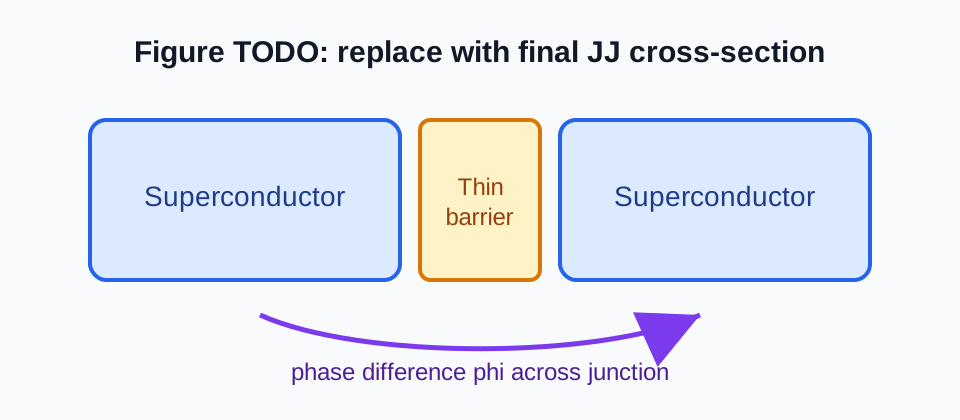
A Josephson junction is the active nonlinear element in many superconducting circuits. It is usually made from two superconductors separated by a very thin barrier. Cooper pairs tunnel through the barrier, so the junction couples the phases of the two superconductors.
If the two superconducting phases are
Most first-pass circuit explanations simply call this
Figure TODO
Recommended figure: cross-section of a Josephson junction, showing superconductor / thin insulator / superconductor and the phase difference
Image path used by this page: /figures/fundamentals/josephson-junction-structure.svg
Why Junctions Matter
A superconducting loop stores quantized flux, but by itself it does not give us an easy digital switch. A Josephson junction provides controlled phase motion:
- below its critical current, it supports supercurrent with zero DC voltage,
- near or above its critical current, the phase can move rapidly,
- phase motion produces voltage,
- a
phase slip corresponds to one flux quantum event.
This is the bridge from superconducting physics to SFQ pulses.
DC Josephson Effect
With no DC voltage across the junction, a supercurrent can flow:
where:
is the supercurrent through the junction, is the critical current, is the phase difference.
This equation says the junction is not an ordinary resistor. It is a phase-controlled nonlinear element.
Josephson Energy
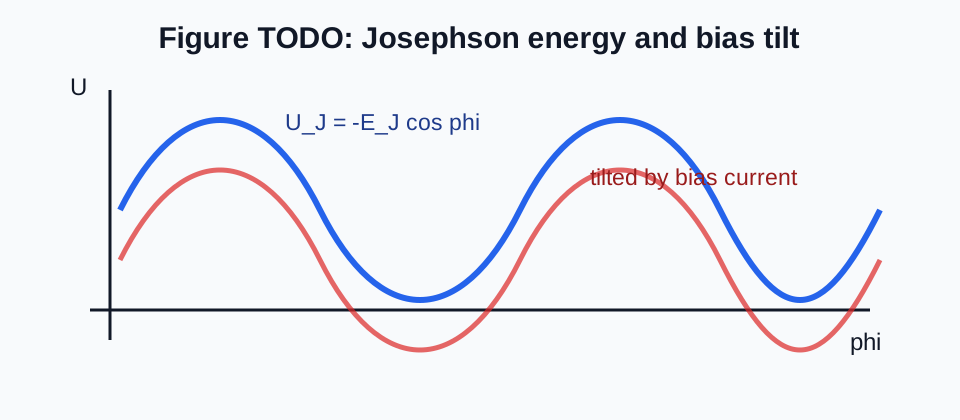
The Josephson current can be derived from a phase-dependent energy:
where:
The current follows from the slope of this energy:
This energy picture is useful because SQUIDs and SFQ gates are often explained by potential-energy wells. Bias current or flux tilts the potential so the phase can move from one stable point to another.
Figure TODO
Recommended figure: Josephson energy
Image path used by this page: /figures/fundamentals/josephson-energy-potential.svg
AC Josephson Effect
When a voltage appears across the junction, the phase changes with time:
Equivalently:
So a rapidly changing phase produces a voltage pulse.
SFQ Pulse Area
For a single
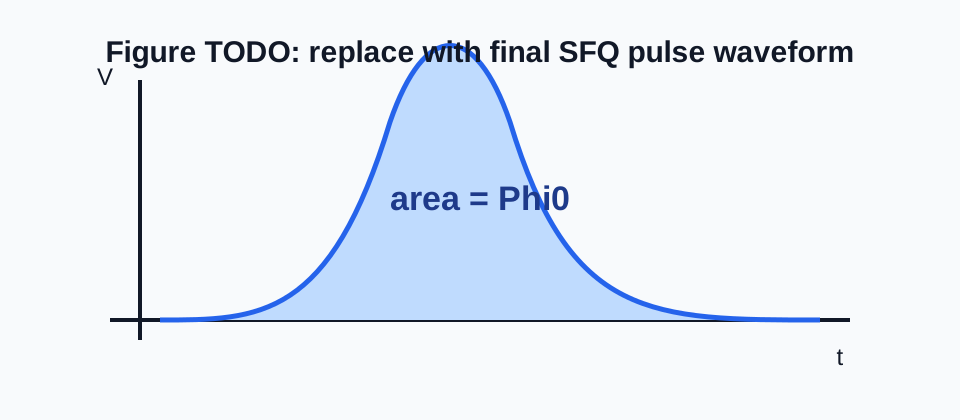
This is why an SFQ pulse is precise. The pulse height and width can change, but the time integral is fixed by the phase change.
Figure TODO
Recommended figure: voltage pulse waveform with shaded area labeled
Image path used by this page: /figures/fundamentals/sfq-pulse-area.svg
RCSJ Model
For circuit design, a Josephson junction is usually modeled by the RCSJ model: an ideal Josephson element in parallel with a capacitance and a resistance.
The current balance is:
Using
This is mathematically similar to a driven damped pendulum:
- phase
behaves like the pendulum angle, - capacitance gives inertia,
- resistance gives damping,
- bias current gives the drive,
- the Josephson sine term gives the nonlinear restoring force.
Damping and McCumber Parameter
The McCumber parameter is commonly written:
Interpretation:
: overdamped, slow but non-hysteretic, : near critical damping, useful for clean SFQ pulses, : underdamped, hysteresis and ringing can appear.
SFQ circuits often use shunt resistors to control damping so the junction switches quickly and then returns cleanly to the zero-voltage state.
Josephson Inductance
For small phase variations, the junction behaves like a nonlinear inductor. Differentiate the DC Josephson relation:
The small-signal Josephson inductance is:
Near
This is why junctions can be used not only as switches but also as nonlinear inductive elements.
Switching Picture
Use this mental model:
- The junction is initially in a zero-voltage state.
- Bias current or flux tilts the phase potential.
- The phase escapes from one well and advances by about
. - A voltage pulse appears through the AC Josephson relation.
- A flux quantum is inserted into or removed from a superconducting loop.
This is not CMOS voltage-level switching. The information is in pulse events and stored flux states.
Beginner Pitfalls
- "Current above
destroys the whole circuit." In circuit operation, the junction switches locally; the surrounding superconducting circuit can remain functional. - "The voltage pulse height is the digital value." In SFQ, the important quantity is the pulse area and its arrival, not a static voltage level.
- "
is just math." It is the physical phase winding that connects Josephson switching to flux quantization. - "A JJ is just an ideal switch." Real junction capacitance and damping strongly shape the pulse.
Training Exercise
- Starting from
, integrate both sides for a phase change. - Derive
. - Starting from
, show that . - Write the RCSJ equation and label which term is Josephson current, resistive current, and capacitive current.
- Explain why an underdamped junction can cause pulse interaction.
Next
Continue to SQUID Basics, where junctions and superconducting loops combine into the energy landscape used for SFQ logic.