
Superconductivity Basics
Superconductivity is not only "very low resistance." For digital circuits, the important point is that a superconductor behaves as a macroscopic quantum system. The circuit variables we use later, such as flux, phase, Josephson current, and SFQ pulse area, all come from this physics.
This page gives the minimum model a new member should carry into SFQ and AQFP work.
What Changes at the Superconducting Transition?
When a material becomes superconducting, a new ordered state appears below its critical temperature
- DC current can flow without ordinary resistive loss.
- The electronic state has a coherent quantum phase over macroscopic distances.
The second point is the one that makes superconducting electronics different from just "cold metal electronics."
Energy Gap
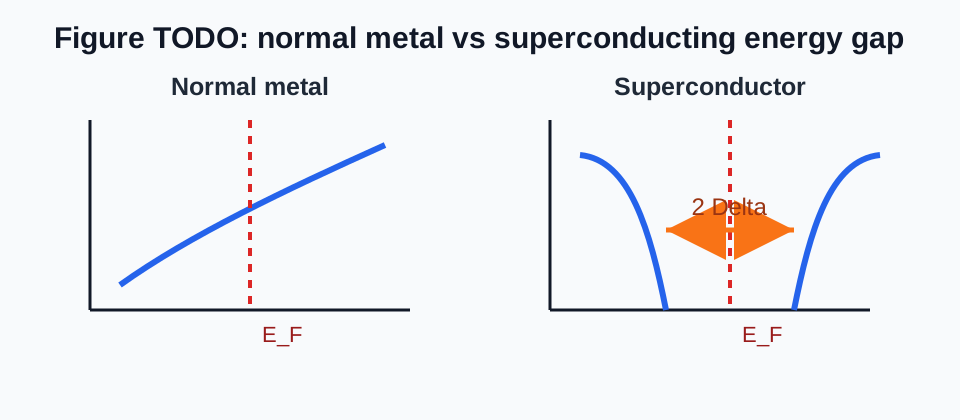
In a normal metal, electronic states are filled up to the Fermi energy
In a superconductor, the ground state is separated from quasiparticle excitations by an energy gap. A common notation is
For a weak-coupling BCS superconductor at zero temperature:
This gap matters for circuits because it suppresses low-energy scattering and defines the energy scale where superconductivity can be broken or quasiparticles can be generated.
Figure TODO
Recommended figure: normal-metal density of states near
Image path used by this page: /figures/fundamentals/superconducting-energy-gap.svg
Cooper Pairs
Electrons repel through Coulomb interaction, so it is not obvious why pairing should happen. In conventional superconductors, the lattice can mediate an effective attraction: one electron distorts the lattice slightly, and another electron can lower its energy by interacting with that distortion.
A Cooper pair has:
- charge
, - opposite momenta in the simplest picture, often written
, - opposite spins for the usual spin-singlet case,
- a spatial extent called the coherence length
.
The pair is not a tiny molecule sitting at one point. It is a delocalized quantum state, often much larger than the lattice spacing.
Macroscopic Wavefunction
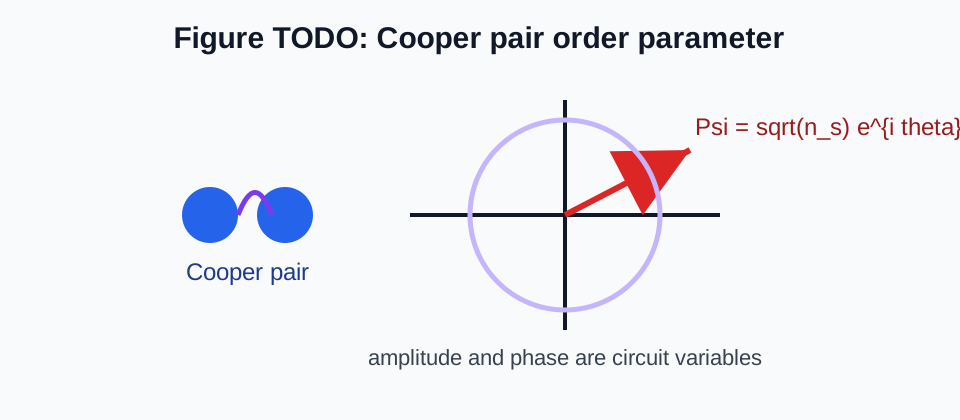
For circuit intuition, we do not track every Cooper pair individually. We use a macroscopic order parameter:
where:
is the superconducting carrier density, is the superconducting phase.
The phase
Figure TODO
Recommended figure: Cooper pair wavefunction / order parameter with amplitude
Image path used by this page: /figures/fundamentals/cooper-pair-order-parameter.svg
Supercurrent From Phase Gradient
A useful expression for the superconducting velocity is:
For Cooper pairs,
The important reading is:
- a phase gradient drives supercurrent,
- magnetic vector potential
also matters, - current, magnetic field, and phase are inseparable in superconducting circuits.
This is why layout geometry and inductance are central in SFQ/AQFP circuits.
Zero Resistance and Meissner Effect
Zero DC resistance means that a persistent current can circulate in a superconducting loop without ordinary resistive decay.
The Meissner effect means the superconductor expels magnetic field from its interior, except within a penetration depth
So magnetic field decays inside the superconductor over the London penetration depth
For circuits, this matters because current is not distributed arbitrarily through the metal. Film thickness, ground planes, return paths, and penetration depth all affect inductance.
Flux Quantization
The superconducting wavefunction must be single-valued. Around a closed loop:
Using the supercurrent relation, a loop deep in the superconductor with no net current in the bulk gives:
Combining the two:
By Stokes' theorem,
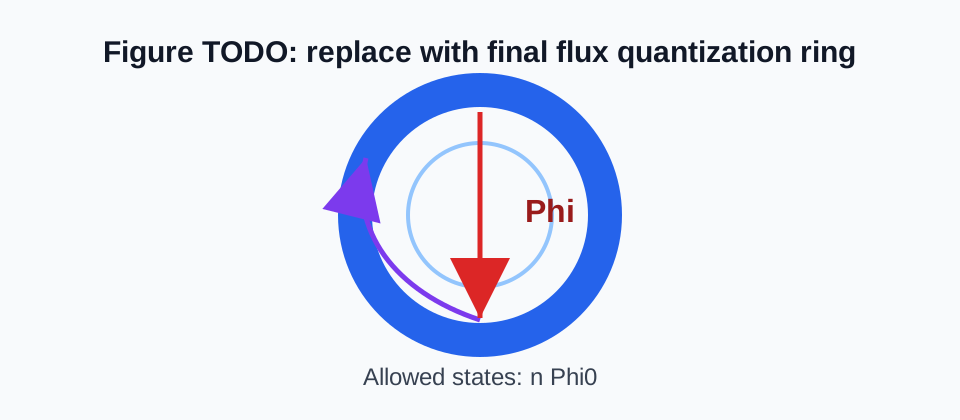
Figure TODO
Recommended figure: superconducting ring threaded by magnetic flux, with allowed states labeled
Image path used by this page: /figures/fundamentals/flux-quantization-ring.svg
Why This Leads to Digital Circuits
Flux quantization gives superconducting loops discrete states. Josephson junctions give us a controlled way to change the phase by
That is the physical basis of SFQ:
Later, the AC Josephson relation will turn this phase event into a voltage pulse with quantized area.
Critical Conditions
Superconductivity exists only inside a safe region of temperature, current, and magnetic field:
, or , or below the relevant critical field for the material.
Leaving that region drives part or all of the material normal. For Josephson junctions, controlled switching near a critical current is useful. For wiring and ground planes, unintended normal regions are usually a problem.
What New Members Should Be Able to Derive
You should be able to reproduce this chain without notes:
- Write
. - State that single-valuedness requires
. - Use the phase/current relation to connect
with . - Use
. - Arrive at
and .
Training Exercise
- Draw a normal-metal energy diagram and a superconducting energy-gap diagram. Label
, , and . - Write the order parameter
and explain what amplitude and phase mean. - Draw a superconducting ring. Mark a flux
through it. - Label three allowed states:
, , . - Explain why
is not a stable allowed state for an isolated ideal ring.
Next
Continue to Josephson Effect and JJ. The Josephson junction is the controllable element that lets flux enter and leave superconducting loops.